
- Register
- ☰
From the Training:
Certified Safe & Loved Practitioner
I bought a new iPhone and the charger stopped working.
I called Apple Support, thinking this would be a simple fix. Instead, the person I spoke with told me I would have to buy another charger.
I told him how can that be the phone was brand new.
He didn’t care.
I told him I had just spent $1,200 and the charger ought to work.
He didn’t care.
I told him the whole thing was absurd.
Still, didn’t care.
I asked to speak to a manager.
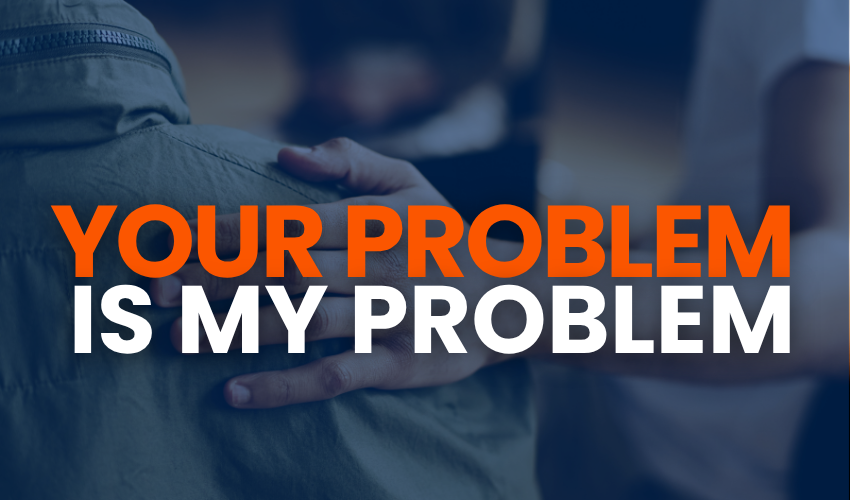
When the manager got on the phone, the first thing he said was, “Your problem is now my problem. I’m going to take care of this. Don’t you worry about it.”
In seconds, everything changed.
The first guy made me feel like I could go pound sand.
The second made me feel like he was totally in my corner.
And here’s the crazy thing.
I so believed that the new guy sincerely wanted to help me that even if he had told me that he couldn’t get me a new charger after all, I wouldn’t have been angry. Disappointed, yes. Angry, no.
I could afford another charger.
The money was never the point. The point was that the first person didn’t seem to care that I had a problem.
But the second guy cared so much that he made my problem his problem.
He promised to put a new charger in the mail the same day, free of charge.
I asked what to do with the broken charger.
“Throw it away.”
I told him the first guy said I had to mail it back so Apple could review it.
He laughed.
“That’s crazy. Why would we want a broken charger? Throw it in the trash.”
My trust in Apple went way up that day and there’s a name for what happened.
The service recovery paradox.
A person whose problem is handled well becomes more loyal than someone who never had a problem in the first place.
That doesn’t just apply to Apple.
Every time a teacher, staff member, student, or parent brings us a problem, we become one of those two guys.
We either make them feel like the problem is theirs and they are alone, or we let them know that we are in their corner and will do everything we reasonably can to help.
One response weakens trust. The other builds it.
One creates friction, anger, and resentment.
The other creates loyalty and sometimes even friendship.
This is a big deal in school safety.
If someone brings us a concern and we dismiss it, minimize it, or give them the runaround, they may not bring us the next one. The problem we handled poorly today may become the warning sign they keep to themselves tomorrow.
It’s true that a problem can weaken a relationship, but it can also become the moment that relationship grows stronger and more loyal.
You were there for me. I'll be there for you!
People may forget the details of the problem and even how it was eventually resolved, but they will remember whether we listened, whether we cared, and whether we stood beside them when they needed help.
You can't solve every problem, but we can make sure no one walks away believing they were left alone with it.
“Your problem is now my problem.”
Say it. Mean it. Prove it.
How you handle 'our' problem will determine whether they trust you with the next one.

Join the Safe & Loved Community and get more tips!
3 Options that will Change Your School

Address
PO BOX 474 Radford, VA 24143
Phone and text
(540) 577-7200
info@donshomette.com
Copyright © 2019 Don Shomette